

It is 6:14 am on a Tuesday. A quality control check at a Tier 1 seat mechanism supplier reveals that an entire batch of precision brackets has failed tolerance testing. The affected components are scheduled to arrive at an OEM assembly plant 420 kilometres away. First shift starts in three hours and forty-five minutes. With 1,200 workers on the floor and a production rate of one vehicle every 68 seconds, every minute of downtime on that line represents an estimated €25,000 in lost output, idle labour costs, and contractual penalties.
This is not a hypothetical. It is a scenario that plays out across European automotive supply chains every week. According to the Siemens True Cost of Downtime 2024 report, an idle production line in a major automotive plant can cost up to $2.3 million per hour, making the price of a single missing component completely disproportionate to its physical value. The bracket may cost €4. The consequence of its absence can cost €200,000 before noon.
For Tier 1 suppliers, avoiding that call to the OEM production director explaining why the line is stopping is not a logistics objective. It is a survival imperative.
Why Tier 1 Suppliers Face a Different Logistics Reality
Not all supply chain urgency is equal. The logistics challenges facing a Tier 1 automotive supplier are structurally different from those of almost any other industry, and standard freight solutions were not designed to address them.
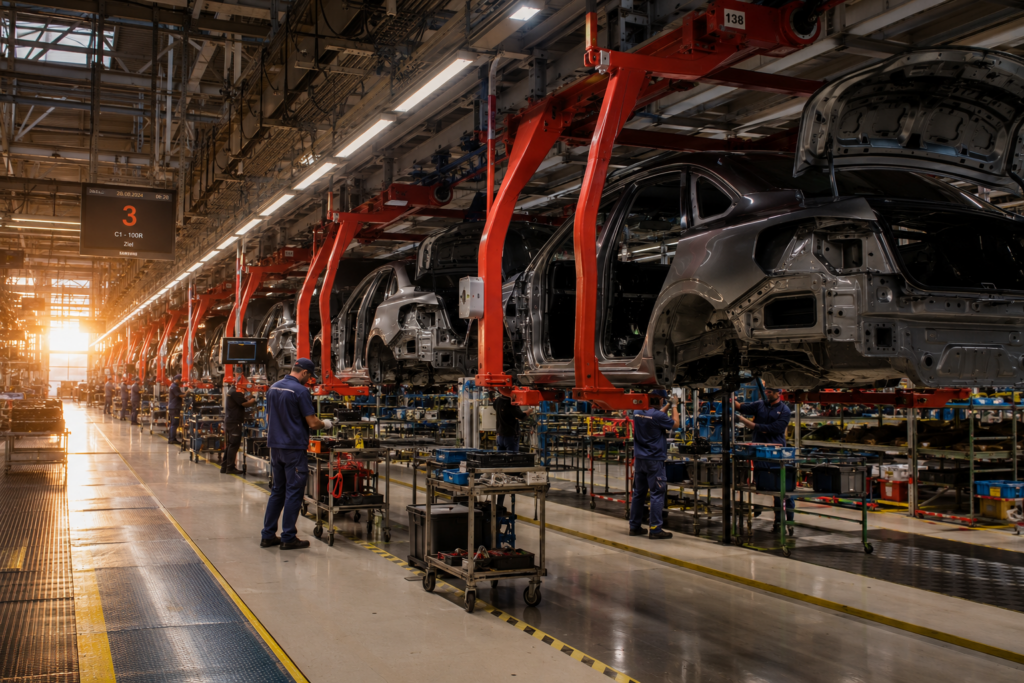
Tier 1 suppliers operate under Just-in-Time (JIT) contracts that leave virtually zero inventory buffer between their delivery and the OEM’s assembly process. Components arrive at the plant hours before they are installed, which eliminates warehousing costs but also eliminates any tolerance for delay. There is no safety stock to draw on. There is no plan B in the traditional sense. There is only the next delivery, on time, or the line stops.
What makes this particularly complex is the position Tier 1 suppliers occupy in the chain. They face direct contractual pressure from the OEM above, with delivery windows measured in hours and SLA penalties that can run into six figures per incident, while simultaneously depending on Tier 2 and Tier 3 sub-suppliers below, many of whom operate with far less logistics sophistication. A quality failure three levels down the chain lands as a Tier 1 problem within hours.
The asymmetry of impact is severe. A single missing sub-component, whether a sensor, a wiring harness, or a fastener, can halt a full production line serving thousands of vehicles per day. It is this asymmetry that defines why standard freight consolidation, built for volume and cost efficiency, is fundamentally mismatched with the operational reality of JIT automotive logistics.
50% of the top 100 global automotive suppliers rely on Flash by Redspher for their urgent and sensitive cargo, precisely because the stakes of getting it wrong are too high to trust to a standard network.
The 4 Most Common Triggers of Automotive Production Shutdowns
Understanding the root causes of production disruptions is the first step toward building a logistics protocol that prevents them. Most shutdowns affecting Tier 1 suppliers trace back to one of four triggers.
1. Quality failure at Tier 2 or Tier 3 level
A batch rejection discovered late in the manufacturing cycle, during final quality control or even at goods-in at the OEM, forces emergency sourcing of replacement parts. The component exists somewhere, but getting it to the right plant in time requires logistics capability that the original supply plan never accounted for.
2. Geopolitical disruption or port congestion
External shocks such as port strikes, airspace restrictions, and conflict-driven rerouting cascade through centralised freight hubs with disproportionate force. The Kiel Institute for the World Economy’s trade disruption tracker monitors these shifts in real time, and JIT supply chains consistently emerge as the most exposed. According to a global operations survey by McKinsey & Company, 82% of industry leaders report their supply chains are currently affected by new tariffs and trade shifts. When a standard groupage shipment gets delayed at a congested hub, the buffer that would absorb that delay simply does not exist in automotive.
3. Demand surge or accelerated production schedule
OEMs sometimes pull forward production schedules in response to unexpected demand spikes or customer commitments. When an assembly programme accelerates by even a few days, the entire Tier 1 supply chain must respond simultaneously. Components that were due to arrive in five days are now needed in two, and the standard freight booking made last week no longer serves the new reality.
4. Carrier failure or missed connection
The transport leg itself breaks down. A vehicle breaks down en route, a driver is unavailable, a flight is cancelled, or a routine customs clearance takes three times longer than planned. In a standard supply chain, a missed connection is an inconvenience. In a JIT automotive context, it is a potential line stop.
How Express Freight Works as a Production Insurance Policy
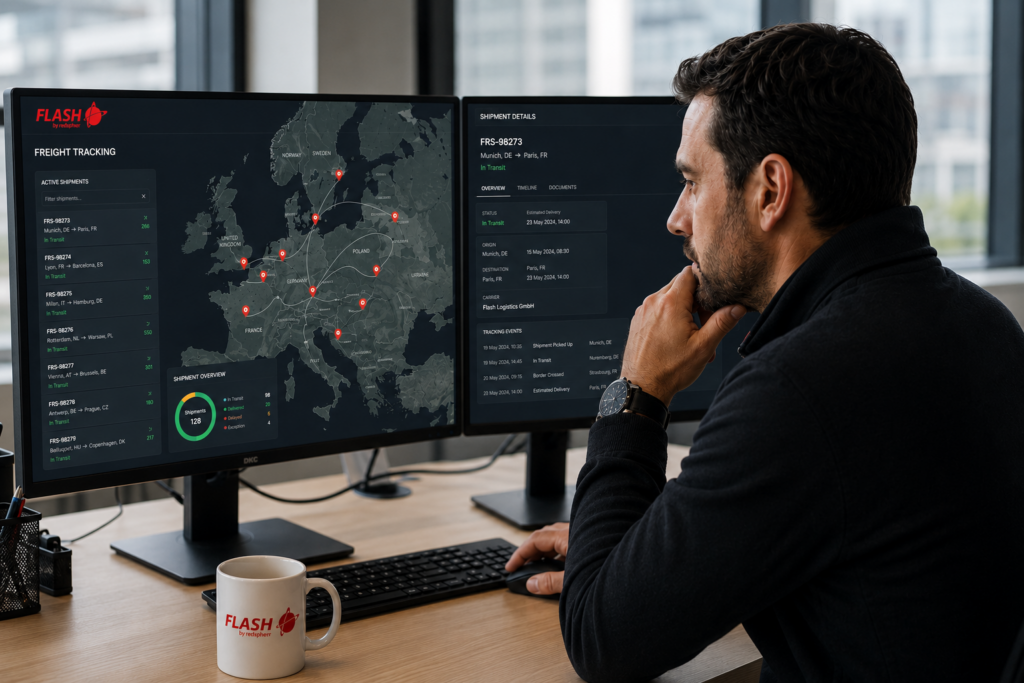
Express freight in the automotive context is not simply fast shipping. It is a dedicated, point-to-point transport chain with guaranteed handling, real-time visibility, and a 24/7 escalation protocol designed to reach a production line before the line stops.
The appropriate solution depends on distance, time window, and cargo characteristics.
Dedicated road transport is the first and most common tool. The shipment receives a dedicated van or truck that travels directly from collection point to delivery address, bypassing all intermediate hubs. For distances up to 800 to 1,000 kilometres, same-day delivery is routinely achievable. For distances up to 1,500 kilometres, overnight delivery is the standard. There is no co-loading, no sorting facility, no additional handling; the chain of custody is continuous from door to door.
Next-flight-out (NFO) air freight applies when distance or time makes road transport insufficient. The shipment is booked onto the earliest available commercial flight, with direct delivery to the plant on arrival. NFO closes the gap on cross-border urgencies that would take 24 to 36 hours by road in under six.
On-Board Courier (OBC) is reserved for the most critical single-piece or small-batch shipments, where a professional physically accompanies the cargo on a commercial passenger flight. This guarantees a continuous chain of custody, eliminates cargo hold risks, and ensures immediate handling on landing. For a component worth €500 whose absence will cost €500,000, the economics are straightforward.
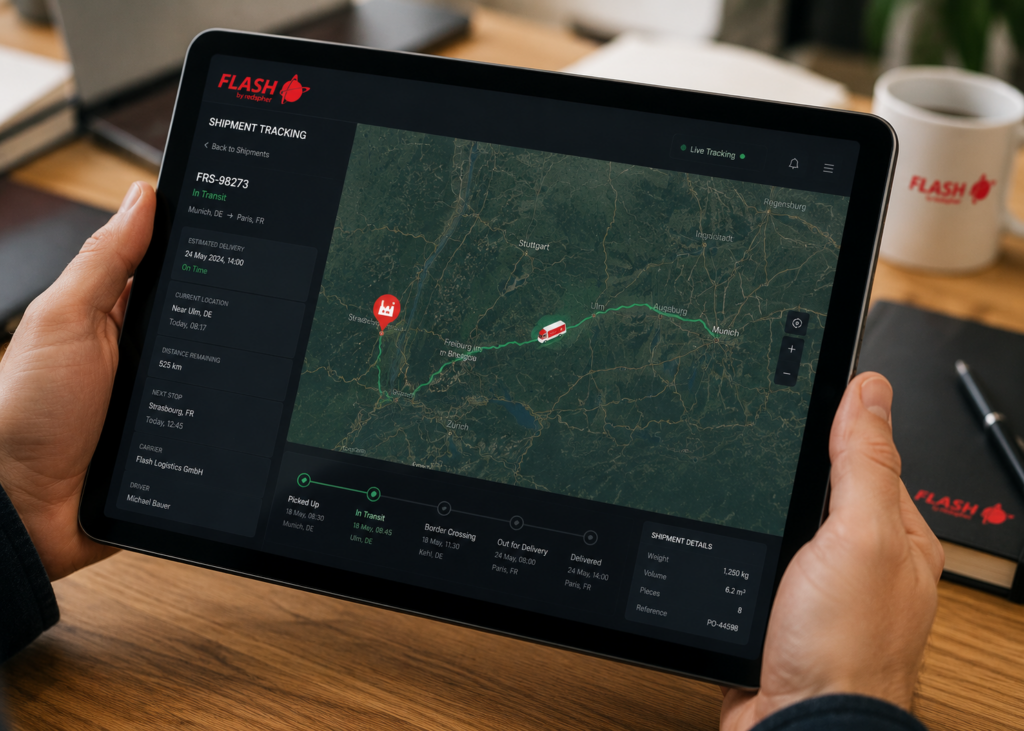
What ties these modes together is not just the vehicle or the aircraft. It is the 24/7 operational layer: a dedicated contact reachable at 3am, a digital platform with real-time tracking, and a carrier network deployed within the hour rather than the day. This is precisely the capability that Flash by Redspher provides to its automotive clients: not a standard booking platform, but a team and infrastructure built around the reality that urgency in this sector does not follow business hours. As the World Economic Forum notes in its supply chain resilience research, severe operational disruptions frequently occur because standard networks fail to prioritise the swift movement of critical components. The service level agreement is not a formality; it is the product.
Building a Proactive Express Freight Protocol, Not Just a Reactive One
The Tier 1 suppliers who manage urgency best are not the ones who find the best provider during a crisis. They are the ones who built the relationship before the crisis existed.
Reactive express freight works. But proactive express freight, embedded as a protocol rather than a panic response, is what consistently prevents shutdowns rather than merely surviving them.
Map your urgency patterns. Most Tier 1 suppliers, if they audit their last 12 to 18 months of emergency freight spend, will find that urgencies cluster around predictable windows: model year changeovers, end-of-quarter production pushes, seasonal demand peaks, and the first two weeks after a new supplier is onboarded. These are not random events. They are foreseeable, and they can be planned for.
Pre-qualify your express freight partner before the crisis hits. This means auditing carrier quality and insurance compliance, establishing dedicated operational contacts, agreeing SLAs for response time and booking confirmation, and testing the integration between your TMS or ERP and the freight platform. A provider you have never used before is not a provider you want to discover at 2am when your line starts in four hours.
Define escalation thresholds explicitly. At what inventory level does a standard freight booking get upgraded to express? At what delay signal does the logistics manager escalate to the plant director? The decisions that get made badly in a crisis are almost always the ones that were never made in advance. Document the escalation logic and make it part of your standard operating procedure, not a judgment call made under pressure.
Integrate your express freight provider into your visibility infrastructure. Real-time tracking data fed into your TMS means your team is not chasing status updates by phone; they are watching the vehicle move toward the plant on a dashboard while managing everything else. This operational visibility is what allows faster decisions when conditions change mid-journey.
The goal is to reach a position where express freight is not experienced as an emergency measure, but as a predictable, budgeted capability that activates automatically when conditions require it.
Frequently Asked Questions
How quickly can express freight reach a European automotive plant in an emergency?
For road express, same-day delivery is achievable for distances up to approximately 800 to 1,000 kilometres, and overnight delivery covers most intra-European routes. For cross-border urgencies requiring air freight, a next-flight-out booking can deliver a component within 4 to 8 hours of departure, depending on routing. On-Board Courier services can achieve door-to-door delivery anywhere in Europe within 6 to 10 hours when a direct flight is available.
Is express freight cost-effective compared to the cost of a production shutdown?
In most cases, yes, and by a significant margin. An emergency dedicated road transport within Europe typically costs between €500 and €3,000 depending on distance and vehicle type, based on current European market rates. A next-flight-out air freight booking for a small component adds €1,000 to €5,000. Against a line stoppage cost that FreightWaves data and the Siemens 2024 report consistently place in the millions per hour for major automotive plants, the ROI calculation is rarely close. The more relevant question is not whether express freight is affordable; it is whether the cost is being treated as a logistics expense or as a production insurance premium, which it effectively is.
How do Tier 1 suppliers identify which freight lanes carry the highest urgency risk?
The starting point is a 12 to 18 month audit of emergency freight spend, mapped against the specific suppliers, components, and time periods that generated each incident. Most Tier 1 operations will find a concentration of urgencies on a relatively small number of lanes and supplier relationships. Those are the routes that warrant pre-agreed express arrangements rather than reliance on spot buying. The McKinsey supply chain risk survey consistently finds that companies who have mapped their risk concentration points recover from disruptions significantly faster than those managing reactively.
What should a Tier 1 supplier look for when auditing an express freight provider?
The non-negotiables are 24/7 operational availability with a named contact, documented carrier vetting and insurance standards, a digital tracking platform that provides real-time shipment status, and a proven response time from booking request to vehicle departure of under one hour for emergency scenarios. Beyond these, the relevant question is whether the provider has verifiable experience in automotive supply chains specifically, given the handling standards, delivery precision, and confidentiality requirements that JIT contracts impose.
How do Tier 1 suppliers integrate urgent freight into their existing TMS or ERP?
Most enterprise-grade express freight platforms offer API integration with standard TMS and ERP systems. This allows bookings to be initiated from within the existing logistics interface, shipment status to feed back into the supply chain visibility layer, and freight data to reconcile automatically against purchase orders. For Tier 1 suppliers managing high volumes of urgent bookings, this integration eliminates manual steps and reduces the time between identifying a risk and deploying a solution.
The Component That Decides Whether a Line Runs
The economics of automotive production are unforgiving in one specific way: the value of any given component has no relationship to its operational criticality. A €3 fastener and a €30,000 sub-assembly are equally capable of stopping a line if either one is missing at the wrong moment.
This is what makes standard freight logic, optimising for cost, consolidating where possible, and using spot buying for exceptions, an incomplete strategy for Tier 1 automotive suppliers. The cost optimisation that consolidation delivers in normal conditions is erased, many times over, by a single unplanned line stop.
Every element of a proactive express freight protocol, from urgency pattern mapping to carrier pre-qualification to escalation thresholds, represents a decision made in calm conditions rather than under pressure. Industry frameworks such as those published by the Automotive Industry Action Group (AIAG) reinforce this, treating supply chain risk mitigation as an operational investment rather than an overhead. Express freight is not a premium expense that sits outside the logistics budget. It is part of the production continuity budget, a calculated investment in keeping the line running, the OEM relationship intact, and the penalty clauses dormant.
Building that capability before it is needed, with a freight partner who is already integrated into your operational infrastructure and ready to deploy in under an hour, is the difference between managing the next crisis and simply surviving it.
Flash by Redspher serves the automotive sector across Europe and globally, with a 24/7 operations team, a curated network of audited carriers, and a digital platform built for speed. If you would like to evaluate your current express freight protocols or discuss how to structure a production continuity logistics plan for your facilities, contact our logistics specialists.
Related reading: Just-in-Time Models Adapting to New Geopolitical Reality Why Smart Logistics Leaders Escalate Freight Modes Flash Automotive Logistics Solutions